

“Do you fancy a trip to Penarth?” I asked my wife last week. She told me she did and even when I told her we’d be going on the bus, the long way round, she was still keen. I’m guessing the fact she’d never caught a bus from the newish Cardiff Bus Interchange that made it sound tempting.
There are buses which go a fairly direct route to Penarth but the No.7 isn’t one of them. It weaves it’s way around Grangetown, diverts up to Llandough Hospital, before weaving again through the streets of Cogan and finally arriving in Penarth almost an hour after starting off.

You need to be a calm and skilful driver to tackle No.7 route. It goes up and down narrow suburban streets where just one badly parked car could mean the end of the journey. The houses of Grangetown were adorned with Halloween decorations. I pretended not to be scared and Margaret told me to stop hiding under the seat.

The bus stopped in Llandough Hospital and the driver turned the engine off and got off. He disappeared into the hospital, I’m guessing either for a pee or very quick prostate examination appointment.
We arrived in Penarth and were met with rain. That’s wasn’t in the forecast. We walked up to St Augustine’s church. I was keen to find a few graves I heard were here such as the grave of Samuel Arthur Brain, the founder of Brains Brewery. Brains SA beer is named him.

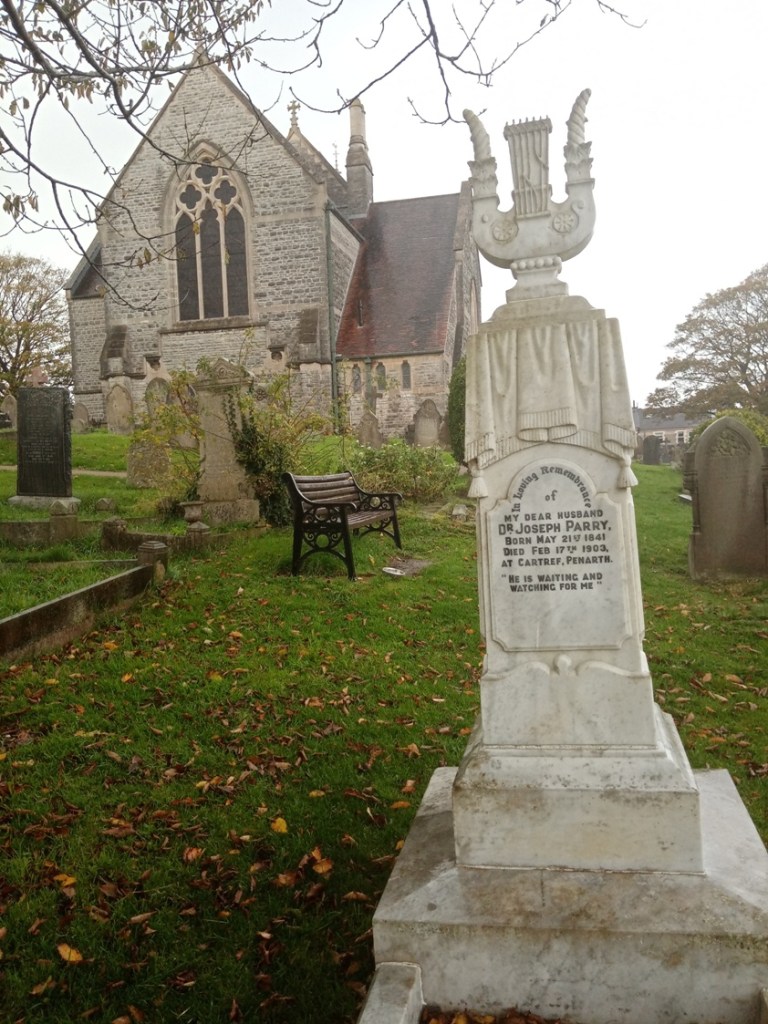
We were also looking for the resting place of the Welsh composer Joseph Parry. I’d recently taken my u3a Slow Train Coming group to see his birthplace in Merthyr Tydfil where we sang his song Myfanwy. After a bit of searching I shouted to Margaret I’d found it. “Liar” she said. “No, honestly, it’s over here” I told her. Turns out she was referring to the lyre, on top of his headstone.
The rain was hammering down now so we retreated into the café in Belle View Park and treated ourselves to coffee and cake. When we finished Margaret said she was leaving me which was a bit of a shock after all these years and cruel considering I’d just paid for the coffee. It turns out she meant she was off to do a bit of shopping and then planned to take the faster bus back to Cardiff. Lightweight.

By now the rain had stopped so I headed down to the seafront via Alexandra Park and onto the pier. This was one of those days where the weather changed every five minutes.

By the time I had walked along the Esplanade and up onto the cliff top the sun was out and temperature soaring. I nipped into the public conveniences to change out of my long johns (let’s be honest, you wouldn’t read a sentence like that from a young blogger).
I sat on a bench on the cliff top and read. Today’s book was one I’d found in a local book-swap thingy and not one I’d ever expect to find there: Heroic Science: Swansea and the Royal Institution of South Wales 1835-1865. The first chapter was all about John Henry Vivian who created the copper industry in Swansea. In those early days it was a filthy process, emitting gasses that withered trees and shrubs and turned the grass yellow. Vivian was wise enough to live upwind in Singleton Abbey, now part of Swansea University. It was especially interesting to me having recently visited Singleton Abbey on a reunion.
When I was there at university I think I only ever went into the Abbey once and that was to register to do a PhD. They looked at the forms and gave them back to me saying they thought it best if I was applying to do a higher degree then I should probably spell ‘research’ correctly and not resurch. Spelling has never been my strong point which together with other traits such as a fascination with lists, like catching buses in numerical order, probably means I deserve a label. I’m however quite happy being called ‘a little bit quirky’.

Anyway, back to John Henry Vivian. The book told me how he tackled the problem of acrid emissions from his factory by setting up a fund with a prize of £1,000 to anyone who could solve the problem. The problem was taken up by famous scientists of the day including Humphry Davy and Michael Faraday. Whilst Davy liked coming to stay at Singleton Abbey to visit the copper works and then partake in social events such as hunting in the Abbey grounds, Michael Faraday found all that rather irksome. My mind went back to our recent tour of the campus and the Abbey and how we were stood in the same room that Michael Faraday and Humphry Davy had once had their evening meals with the Vivian family.
I strolled back to the middle of Penarth along the old railway track before catching the No.7 bus back to Cardiff where the sun set on another bus-book-beverage adventure.






 Cardiff Capers