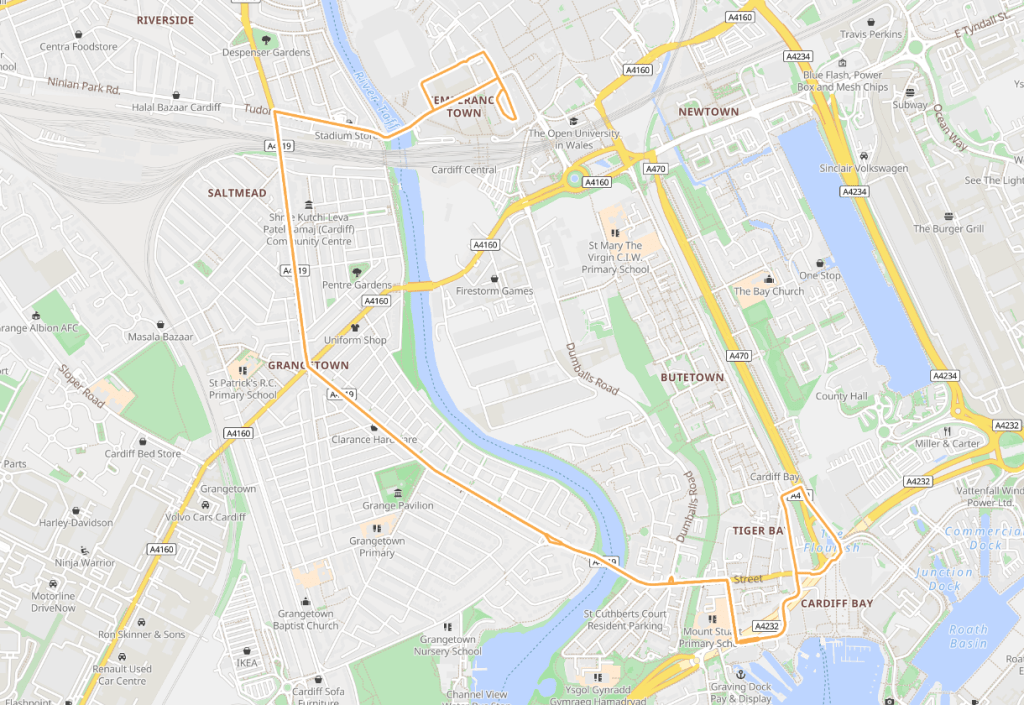
I was early for my No’8 Cardiff Bus to Cardiff Bay via Grangetown so went for a wander around Central Square. It’s a dangerous time of year to dawdle around there as you may get speared in the head, not by Cupid’s arrow but by a ripened seed pod from what looks to be a Catalpa bean tree of some sort. I won’t complain though. I’ll leave that to the many others who moan about the lack of greenery in Central Square and continuously mention the words ‘Why don’t the Council…….’ in their social media posts. That reminds me. There must be a huge opportunity awaiting for anyone who can develop a Google Extension or alike that filters out posts containing the word ‘Council’.
Catalpa bean tree in Cardiff Central Square
I still had time for another find before I caught the bus, this time a mislaid passport left on a bench in the bus station. I pictured someone on the way to the airport and barred from boarding their flight without their passport. This one however was battered with ripped pages and more likely used for ID purposes that international travel. I handed it in to one of the attendants. These finds are getting a regular occurrence. It was a mobile phone when I was on the No.6 route.
I like the No.8 route. Instead of going direct to Cardiff Bay from the centre of Cardiff it does a sort of slingshot type route through the multi-cultural community of Grangetown. I got off part way and visited Grange Gardens, one of the smaller but still splendid Cardiff Victorian parks. It has been modernised with an up-to-date playground and five-a-side football pitch but still has relics of the past in the form of a war memorial, bandstand and not forgetting the park caretaker’s shelter complete with Cardiff motif above the door. In 1938 an inventory was made of the contents of the shelter and it included pruning saw, axe (felling), a set of drain rods and kettle (copper).
Grange Gardens, Grangetown
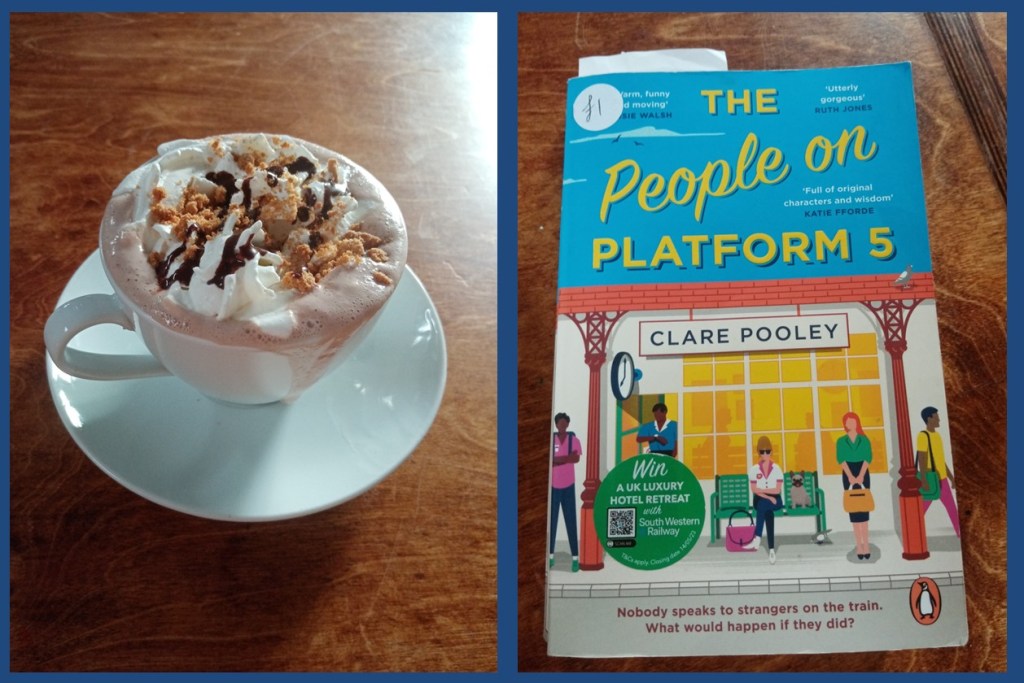
I went into the Pavilion in search of a bite to eat and a beverage. It was a hive of activity. There’s a lot of community initiatives going on in here and a pleasant atmosphere. I had a seasonal biscoff hot chocolate and cheese and chutney toasty. The menu appeared to comprise of three type of cheese toasty: cheese and jalapeno jam, cheese and chutney and 3-cheese toasty. I was tempted to ask what their signature dish was but thought better of it. Bet it included cheese.
My book today was ‘The People on Platform 5’ by Clare Pooley. I must admit I had picked it up in error in a charity shop. I thought it was going to be travel book but it’s actually a novel. When I discovered this I feared it may be chic-lit but I’m halfway through and no chicken has appeared nor fowl of any sort. Actually, it’s pretty good read, very funny, about a group of people on commuter train who break the rules of commuting and start talking to each other. My only disappointment is there’s no mention of the types of trains e.g. are they loco-hauled or multiple-units?
Biscoff Hot Chocolate and Clare Pooley The People on Platform 5
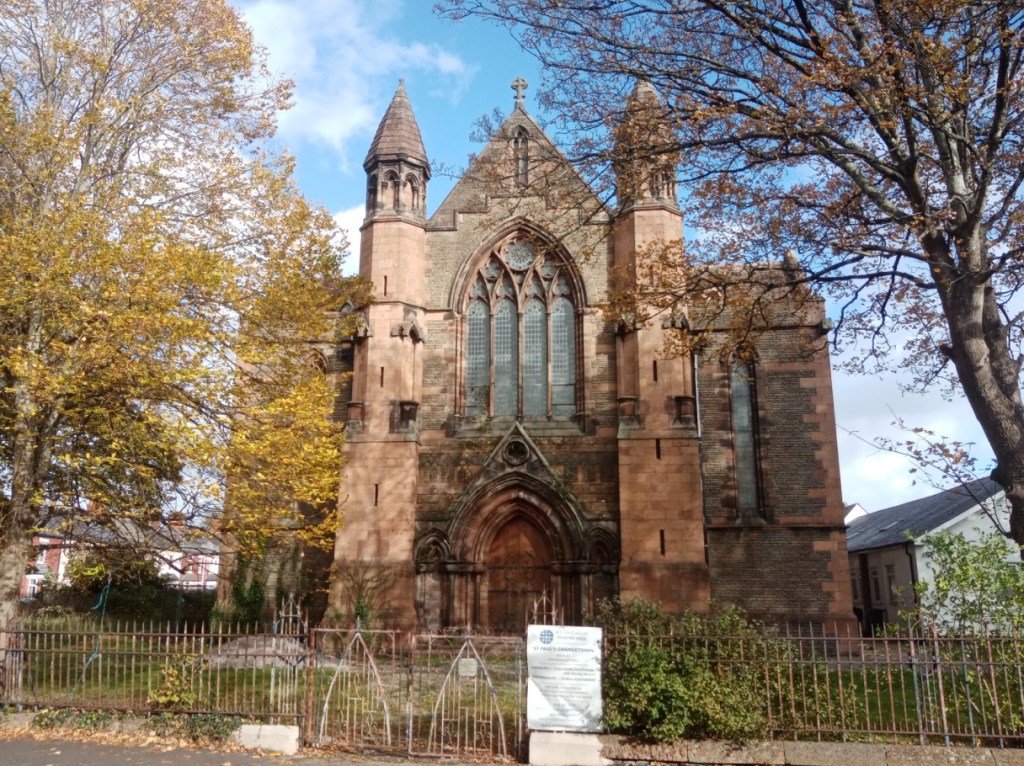
I still had time after lunch for a walk around the streets Grangetown with its Victorian schools and churches. I even went down to the Taff embankment and had a view back up the river towards the Principality Stadium in the distance.
St Paul’s Grangetown Cardiff
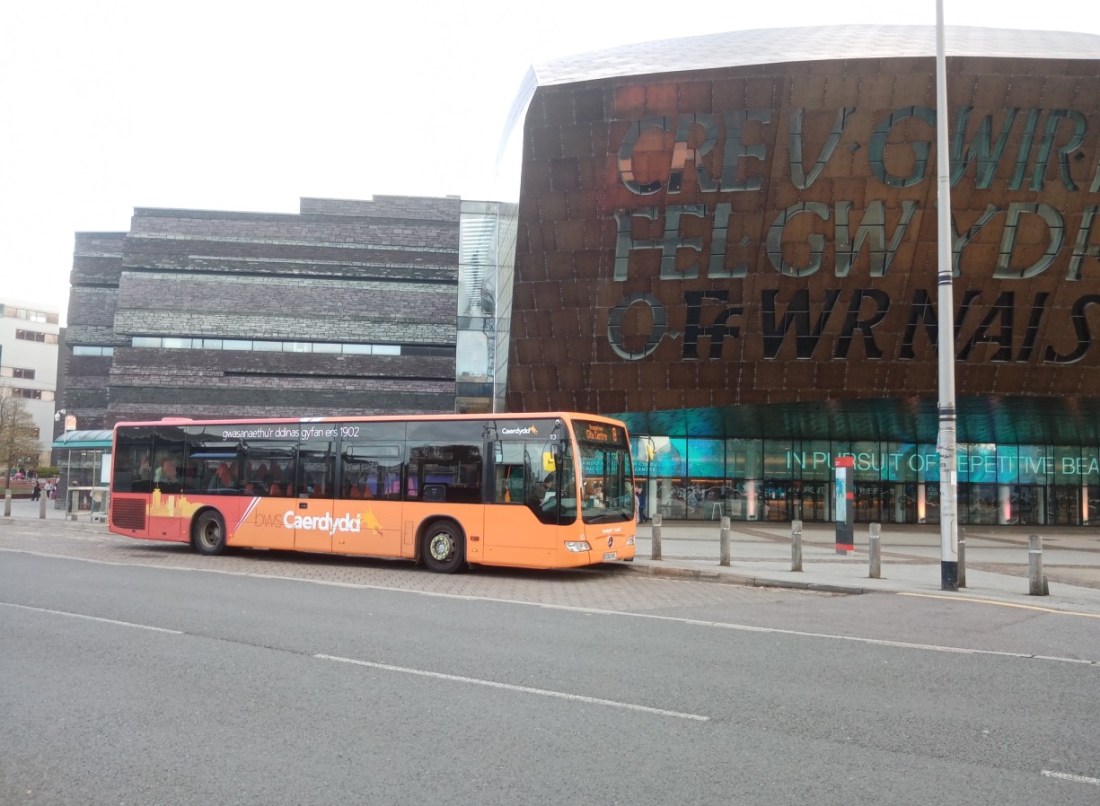
I then rejoined the No.8 which took me down to its terminus at Cardiff Bay and after a five minute scamper around the area and hopped back on the same bus to bring me back to town.
A new idea for autumnal days when the weather is looking a bit inclement.
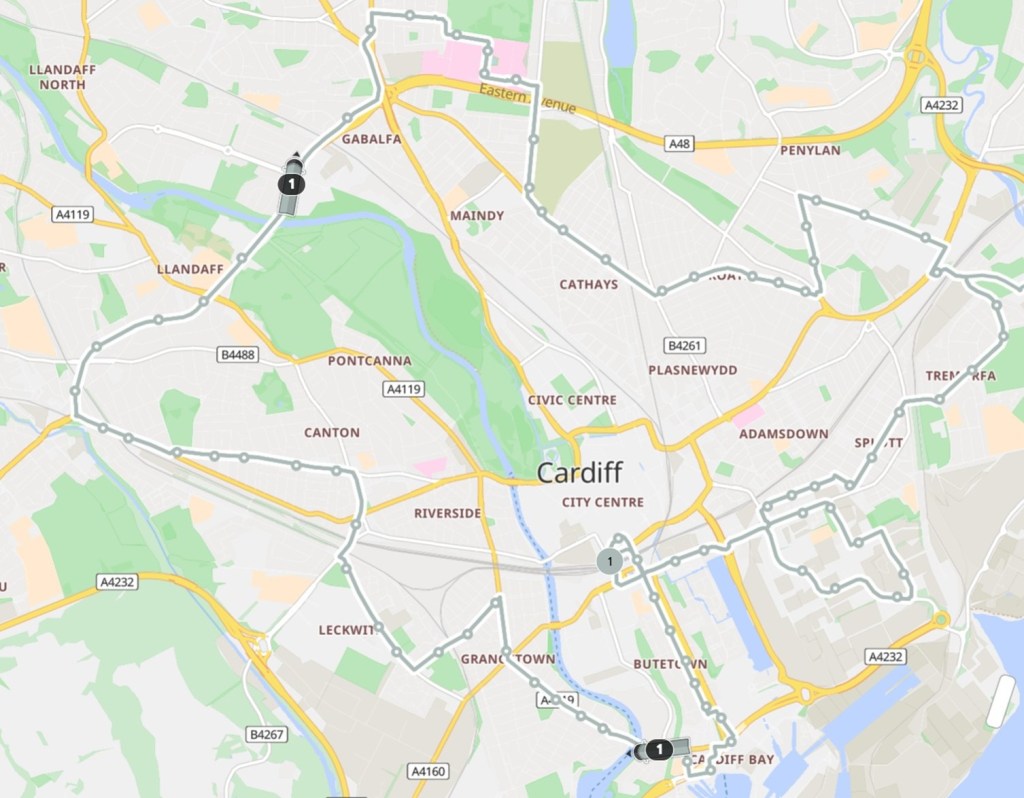
I was introduced to the bustimes.org website recently. Fascinating stuff. It got me thinking of something I could do on days when the sun isn’t shining and I know I shouldn’t be spending all the time hunched over a laptop.
Accompanying me on my journey would be a book for when I got bored with the view out of the window or people watching on board the bus. I’d also aim to take in a beverage of some sort at some stage on the journey.
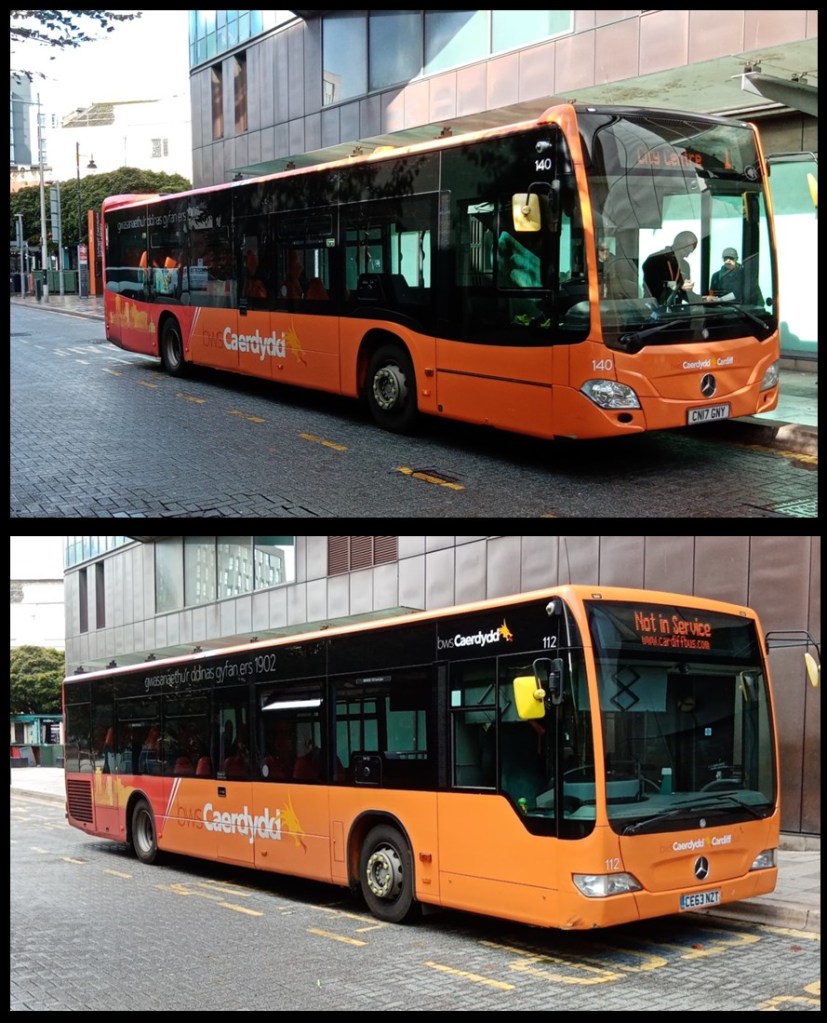
Cardiff Bus No.1 Canal Street
So today I felt like Laurie Lee stepping out on a new adventure, my senses heightened.
Embarking passengers took part in the wobbling skittles game i.e. could the somewhat heavy-footed driver make us fall over before we got to a seat.
I alighted at the terminus in Canal Street and went and had a coffee in John Lewis. The 3rd floor café is very tranquil, a good place for a read.
John Lewis, Cardiff
I’m part way through ‘The Golden Orphans’ by Gary Raymond. He is an author, critic and presents of The Review Show for BBC Radio Wales. It’s good quality descriptive writing which I’m enjoying.
Gary Raymond – The Golden Orphans – John Lewis Cafe
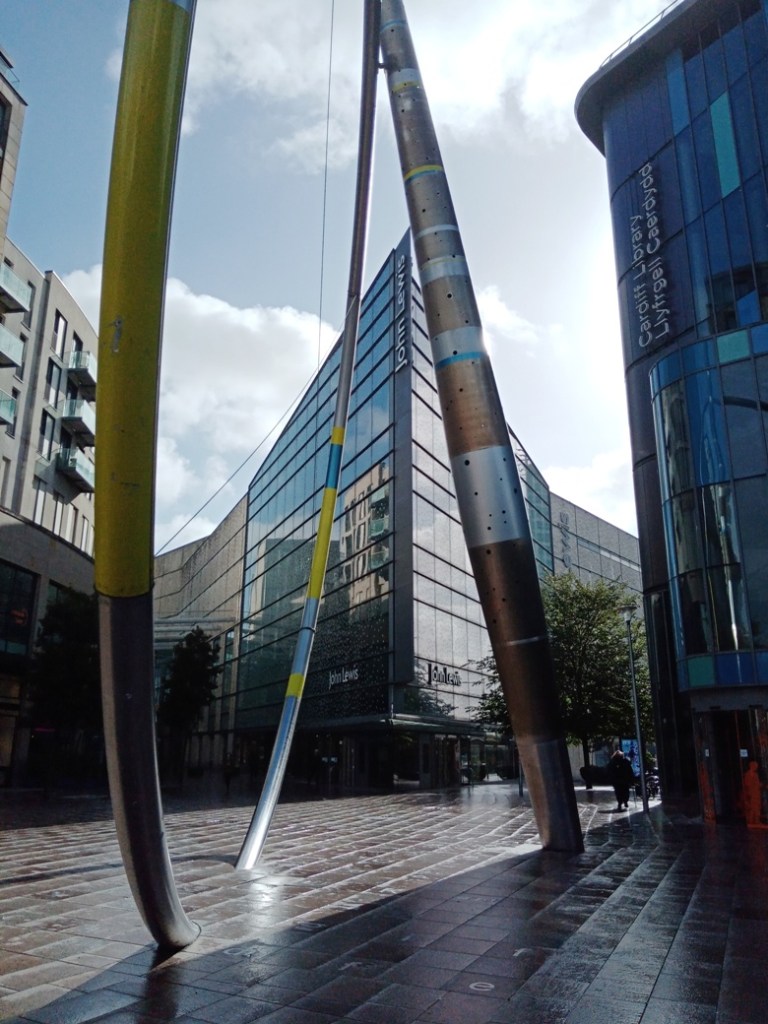
I mooched around the Alliance sculpture by French installation artist Jean-Bernard Metais outside the library. I think it’s somewhat changed from its original installation, less reliance of moving parts and projected images, but still an impressive piece of art.
Alliance sculpture Cardiff
I caught another No.1 to continue my clockwise journey which stopped off at the hospital for those people requiring A&E after a somewhat jerky ride. Fortunately, I arrived home unscathed and am now working out the intricacies of the No.1A bus.
I admit it. I wasn’t looking where I was going and I almost bumped into Nye Bevan. It suddenly struck me I didn’t know nearly enough about this man leaning forwards on his pedestal and seemingly telling me to walk to the left hand side. I wasn’t the first to misconstrue the meaning of his posture. I later discovered that for years Michael Sheen referred to him as the ‘Don’t go to Pizza Hut man’.
I knew very little about Nye other than he was Welsh and the man credited with launching the NHS. Time to find out a bit more. My search took me up to his hometown of Tredegar and beyond, but more of Nye Bevan another time.
Staring up at Nye wearing his suite, another question occurred to me. Who was the sculptor and did they make anything else? I found the answer to that question quite fascinating and here’s what I found:
The man who made Nye Bevan was Robert Thomas. First let’s look at what else he made and then I’ll come back to look at the man himself.
Nye Bevan has been here in Queen Street since 1987. He was unveiled by politician Michael Foot, the ex-leader of the Labour Party. Michael Foot had strong links to Bevan in that he lived in Bevan’s hometown of Tredegar when he was MP for the area. Also present at the unveiling in November 1987 was Neil Kinnock, the then leader of the Labour Party. I haven’t been able to find a picture of the unveiling, only a tiny bit in a paper quoting Kinnock who had been asked about Arthur Scargill, the National Union of Miner’s union leader. Kinnock said in response to a question ‘I thought we were here to talk about Nye Bevan, a real socialist’.
It turns out there are two other sculptures by Robert Thomas in Queen Street and one just a few yards off Queen Street, at the top end of Churchill Way. They are sculptures I am familiar with having walked up and down Queen Street many times but it wasn’t till now that I learnt they were by the same man. I took a wander up the road to remind myself of them.
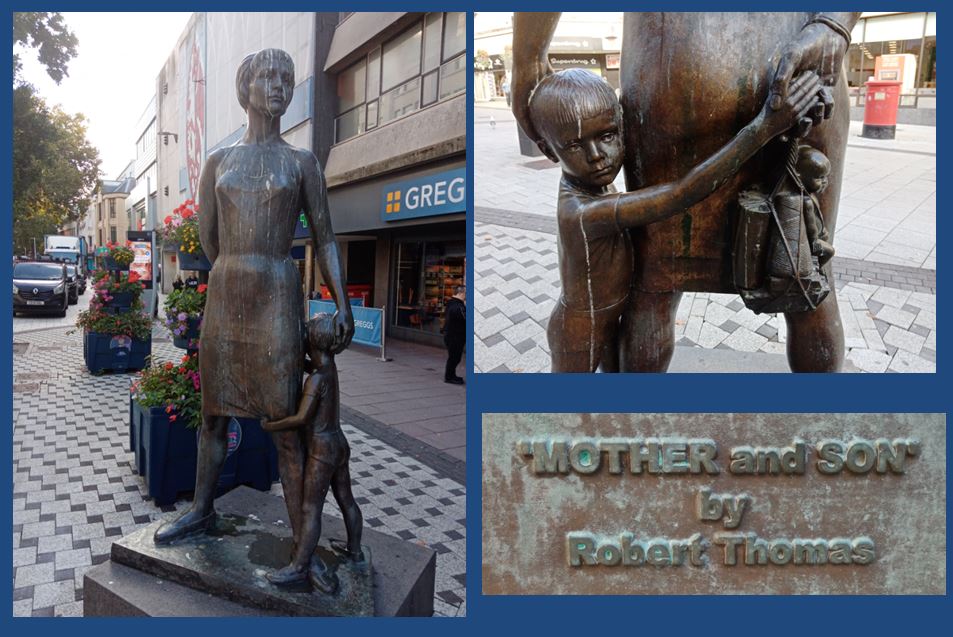
The first one I came across, was Mother and Son. It’s outside Greggs if that helps. It is described as ‘A woman in a summer dress, standing with her head turned to the left, her right hand at her back holding a string bag, and a young boy hugging her left leg, all mounted on a shallow plinth, set on a square-plan base’.
When I researched Robert ‘Bob’ Thomas I learnt this was his first significant work and dates back to a design of his from 1963. He won a commission in a national competition, the Sir Otto Beit prize, to make a sculpture to go in Coalville town centre in Leicestershire. A newspaper of the time makes interesting reading from a historical point of view. It states that ‘Coalville has become and will continue to be something of a boom town. A new power station is being built there and the mine has been contracted to supply fuel for it. With the new prosperity arriving in the town a new shopping centre was constructed and a motif was sought to decorate it’. Thomas’s sculpture was that motif. Strange to think that the coal powered power station and mine have been and gone but it turns out the sculpture is still there but looks now to have been moved to outside their library.
For a long time I thought that the sculpture in Cardiff was the one from Coalville, but no, it must be a copy. Although they look the same they seem to have different names with the one in Cardiff called ‘Mother and Son’ and the one in Leicestershire called ‘Mother and Child’. It makes me wonder where all these moulds are stored? I even wondered whether they were exactly the same, whether the Coalville sculpture has the string bag containing the child’s doll, behind her. Then I found an old photo of the Coalville sculpture and see it does.
Next on my visit was ‘Family’ at the top of Churchill Way. It depicts a mother, father and two children happily occupying a simple bench. Again, it is a copy the original one that dates from 1985 and is in Ealing Broadway Shopping Mall and called “Teulu Family Group”. I like this sculpture though feel it somehow misses a trick. It there were a gap on the bench for someone to sit it would become a good sit-by-me photo opportunity for people. Then again, that’s probably not the point here.
Family by Robert Thomas in Churchill Way, Cardiff
Back on Queen Street and opposite the entrance to Windsor Place is ‘Miner’. A larger than life depiction of a strong and proud South Wales miner carrying his lamp. Created 1993 this one is said to ‘celebrate the city’s heritage as one of the world’s most important coal exporting ports and its links to the coal industry. A tribute to the South Wales coal mine workers, that made Cardiff so rich’. I wonder whether it is also meant to make you think about the degree of exploitation that took place and to contrast the wealth of Cardiff in comparison to the mining towns in the valleys.
I later learnt that these three sculptures, the ‘Miner’, the ‘Family’ and ‘Mother and Son’ were commissioned by Cardiff Council as part of the 2005 anniversary celebration to celebrate Cardiff’s Centenary as a City and its half century as capital of Wales.
There was one other Robert Thomas sculpture in Cardiff that I was reminded of. It’s simply called ‘Girl’ and is in the Gorsedd Gardens opposite the Museum. ‘A young girl sits on a shallowly-stepped plinth, her chin on her left knee, her hands clasping her ankles. The figure is mounted on a rectangular pedestal, itself on a larger base’. It makes a nice contrast to the four large historic statues that also occupy the area.
I asked a friend, much more knowledgeable than me, what his interpretation of these works is. He came back with:
He has used bronze/metal – normally associated with nobility/heroes to depict the working class (and family- including women, highly unusual). Their poses support this – their deportment is heroic. They are on the floor (most of them) so they are ‘grounded’ in with US and live among us – we become, hence, ‘heroes’. They resemble some of the idealist faces/bodies as deployed by the USSR and China of the 50s and 60s in their realism. There is much movement in his work, which is naturalistic, anatomically correct and is pared down (but gives enough detail) without superfluous elements which would distract from his message.
Note the contract between Thomas’s sculptures and the new Betty Campbell sculpture in Central Square that is packed full of detail.
Robert Thomas lived in England after going to in his early career. On his return to Wales it is said he found a society that was de-industrialising, and a confused and disgruntled community in the process of forgetting its history. He set out to identify his heroes, to celebrate them in his work and to find places for that work in public spaces.
As the public became familiar with his sculptures, a new interest in history and Welsh artistic identity was becoming apparent. His bronzes and full-length studies were icons of a Wales arriving at a fuller sense of itself and he captured the physical and spiritual essence of his subjects with naturalism and realism, always streamlined into a classical, heroic formalism. They are stunning representations of Welsh life.
Thomas was recognised as one of Britain’s most successful figure sculptors. He was also admired as one of the artists who had helped to inject a new confidence into the Wales of the 1980s and 1990s.
I later learnt that there was another piece by Robert Thomas. It was a bust of Lady Diana and in St David’s Hall. Try as I might I just couldn’t find an image of this anywhere so made another trip into town to take a look. I feared I may be there for days as I knew St David’s Hall is on six floors and has a labyrinth of corridors. In the end I didn’t have to try too hard. Diana is right there in the foyer next to the escalator.
It was commissioned by Cardiff City Council and Bob Thomas travelled to Kensington Palace for sittings reporting that he found her a charming person with natural warmth, naturally friendly and not aloof. It was completed in 1987 and presented to the city of Cardiff by members of the House of Lords on 21 July 1989.
It was towards the end of my research that I came upon a YouTube video of the Robert Thomas Cardiff sculptures. Included in the video is an information board on the sculpture trail. I can’t believe I’ve never noticed the board. In fact there are two, both the same, one by the ‘Miner’ and one by ‘Mother and Son’. The board mentions the sculptures I had already visited plus a 1983 bust of Gwyn Thomas in the New Theatre. Time for another trip.
The Gwyn Thomas bust is also easy to find. It’s there in the foyer of the New Theatre surrounded by spider plants. Very 1980s. It was unveiled by Sir Anthony Hopkins. I didn’t know anything about Gwyn Thomas but he seems quite a character. He is described as a writer, dramatist, Punch columnist, radio broadcaster and raconteur. I enjoyed watching this YouTube video about him.
I also realised that I’d seen a couple of Robert Thomas sculptures elsewhere recently when I was on my train travels. These were in front of the Treforest campus of the University of South Wales.
So where else may you be lucky enough to see a sculpture by Robert Thomas? I think my favourite is not in Cardiff but in Swansea Marina and is Captain Cat. It has the inscription: “The sleepers are rung out of sleep with his loud get-out-of-bed bell” from Under Milk Wood by Dylan Thomas. It was unveiled in 1990. The sculpture depicts the old blind sea captain who dreams of his deceased shipmates and lost lover Rosie Probert. He is one of the most important characters in Under Milk Wood, as he often acts as a narrator. He observes and comments on the goings-on in the village from his window whilst looking out towards ‘the clippered seas he sailed long ago when his eyes were blue and bright.’
And for those of you who have ventured further west you may have been lucky enough to catch sight of Victorian engineer Isambard Kingdom Brunel at the former Great Western Railway terminus in Neyland, Pembrokshire. It was Thomas’s last work and unveiled shortly after his death by the Prince of Wales. Unfortunately it was stolen a year later by metal thieves but has now been replaced with an replica copy. Swansea-based artist Ceri Thomas, the son of the sculptor, was among those at the unveiling of the replacement sculpture.
Keep your eyes peeled when you are travelling around. You may be lucky enough to see some of his other works including Miner and his Family in Tonypandy or Hebe in Birmingham.
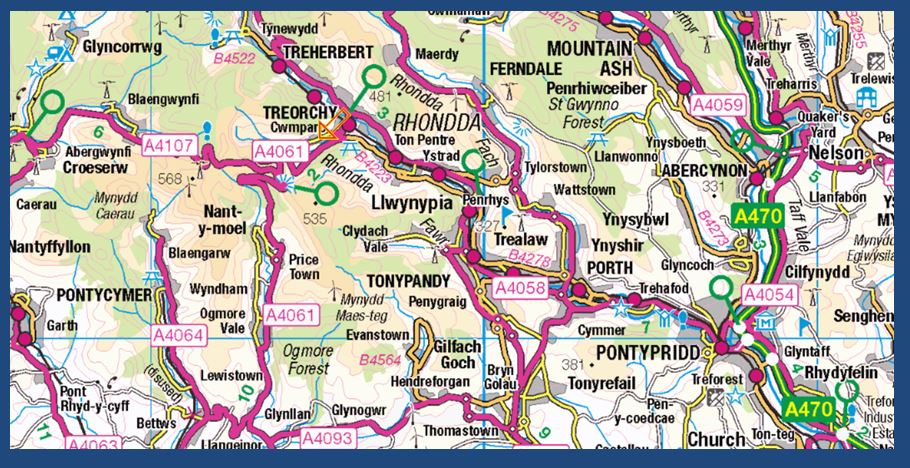
And what of the man himself; sculptor Robert John Roydon Thomas? He was born in Cwmparc in the Rhondda Valley in 1926 to Thomas Thomas, a miner, originally from Ystrad and Miriam Thomas née Wattley, originally from Treorchy. Robert left Pentre Grammar School in 1944 and did war service as a mining electrician before entering Cardiff College of Art in 1947. After that he won a scholarship to the Royal College of Art in London. He then got a job as a lecturer at Ealing Technical College in West London (1953–71) whilst at the same time seeking to further his career as a sculptor.
Cwmparc, Rhondda Valley
In 1952 he married textile designer Mary Elizabeth Gardiner from Barry. She had also attended Cardiff College of Art and went to the Royal College of Art. They had three children together including Ceri Thomas who himself became an artist and has a base in Swansea. The Thomas family returned to Wales to live in Barry in the early 1970s where Bob continued his work as a sculptor. He died in May 1999. Six years later his widow Mary was instrumental in helping bring to fruition the major project to place a set of Robert’s bronze sculptures in the centre of Cardiff.
What was he like as a person? One newspaper article described him as ebullient, cheerful and full of energy.
The other interesting angle of Robert Thomas’s life that I picked up on was that he was part of the ‘Rhondda School’ of artists. This wasn’t a group of artists that follow or establish any particular style as art ‘schools’ tend to but rather a group of students from Cardiff College of Art that used to travel down the Rhondda Valley each day on the steam train too get to their classes at Cardiff College of Art. They used to spread their work out on the table in their train compartment and discuss the merits.
Cardiff College of Art has had many homes over the years but at that time it was in the Friary Building, what previously used to be St John’s School. I think there used to be an older part of St John’s School nearer Queen Street which was demolished but this was in the taller brick building behind. It later became part of UWIST.
I learnt about the Rhondda School from an interesting article by Phil Carradice which states that ‘The legend about these six men states that they would spread their drawings and paintings across the seats of the railway carriage – thereby discouraging anyone else from entering the compartment – and discuss painting and art for the full length of the journey. For two hours, as the old steam train rattled down the valley, these eager and dedicated men would discuss art with all of the bravado and enthusiasm that go with youth, talent and emerging skill.
The men in question were Ernest Zobole, Charles Burton, Glyn Morgan, Nigel Flower, David Mainwaring and Robert Thomas. They came from different locations in the Rhondda and so boarded the train at different times and at different stations but their aim was the same – to discuss art and artists’.
I set out to find out something about each of the artists in the Rhondda School. This is what Wikipedia and similar sites have told me about the artists:
Ernest Zobole
His art output depicted the Rhondda Valley, Welsh life and landscape. His career spanned half a century and remains one of Wales’ most important artists.
Ernest Zobole was born in April 1927 in the industrial Ystrad Rhondda to parents who had emigrated from southern Italy in around 1910.
He was educated at Porth Grammar School and spent five years training at Cardiff College of Art, after serving with the British army in Palestine and Egypt. He married his childhood sweetheart, Christina Baker, after completing his military service.
Zobole taught at Llangefni in Anglesey from 1953 for four years, but found the area desolate and featureless and soon returned home to the Rhondda. In 1957 he taught at a Church in Wales school in Aberdare for two years and then moved closer to home by taking up a post at the County Secondary School in Treorchy.
From 1963 Zobole was based at Newport College of Art, where he would remain until his retirement. In 1965 he won a bursary from the Welsh Arts Council and in 1974 was commissioned for a painting for the foyer of the Welsh College of Music and Drama.
Zobole took early retirement from teaching in 1984, after which he was able to concentrate solely on his painting. He was made an Honorary Fellow of the University of Wales Swansea in 1996.
His wife Chris died in 1997 and Zobole died two years later at Llwynypia, Rhondda Cynon Taff in November 1999. He was awarded a posthumous doctorate by the University of Glamorgan in 2001.
Charles Burton
Charles Burton was born in Treherbert in 1929, and grew up in the Rhondda Fawr between the wars. By his early twenties his work was being bought by public institutions and important private collectors, and in 1954 aged only 25, Charles won the Gold Medal for Fine Art at the National Eisteddfod. At Cardiff College of Art in the late 1940s he was at the heart of the Rhondda Group, alongside his friends Ernie Zobole and Glyn Morgan. After post-graduate studies at the Royal College of Art, he became a teacher. He was Head of Painting at Liverpool College of Art and then, from 1970 to his retirement, Head of Art and Design at the Polytechnic of Wales.
He has always been a very private painter. Like many of the artists we value most, he paints not for an audience, but for himself. He has embraced many subjects: landscapes, still lives, interiors and figures; but his works are unified in a painterly balance of pictorial space and in the love that they express. They need a kind of reverie to be absorbed. So quietly perfect are they that they may be lost to those who hurry for an instant impact, but look long and hard and they will never lose their value.
Glyn Morgan (1926 – 2015)
Educated at Pontypridd Grammar School then at Cardiff School of Art (1942-1944) under Ceri Richards (1903-1971) and he belonged to the so-called Rhondda Group and, during these early years. Morgan painted fine studies of the industrial landscape around where he had been born, at the junction of the Taff and Rhondda valleys. In the summer of 1944 he spent a study weekend at the East Anglian School of Painting at Benton End, Hadleigh, Suffolk and then studied at the Camberwell School of Art (1947-1948) after which he returned to Benton End. After his training at art school and a period in Paris, Glyn followed his mentor & teacher, Cedric Morris at the East Anglia School of Painting & Drawing, where he settled with a studio, and lived most of his life in Suffolk.
David Mainwaring (1933–1993)
Painter, draughtsman and teacher, born in Treherbert, Glamorgan, one of the Rhondda Group, whose wife Barbara was an artist. He gained his National Diploma in Design at Cardiff College of Art, 1953; his Art Teacher’s Diploma there, 1954; and a Diploma in Art Education, University of Wales, 1967. Mainwaring completed a dissertation on the organisation of colour in children’s drawings. He taught art at Bodrinallt Secondary School, Rhondda, 1956–7; at Neath Grammar School for Girls, 1958–66; then was senior lecturer in the postgraduate art education department at South Glamorgan Institute, 1967–84. In 1987 vision in one eye, which had gradually worsened, suddenly failed and Mainwaring had to have two major eye operations and laser treatment to save his sight, leaving him with impaired vision.
Nigel Flower
Painter, designer and teacher, born in Ashbourne, Derbyshire. Flower attended Cardiff College of Art, 91947–53), then held a number of teaching posts, returning to Cardiff College, 1964, to study graphics and photography. He then joined Rhondda Borough Council, in Wales, as a graphic designer and photographer. Showed Royal National Eisteddfod, SWG and WAC, which holds his work.
What next?
I suppose after all that I’d better get busy looking at Nye Bevan.
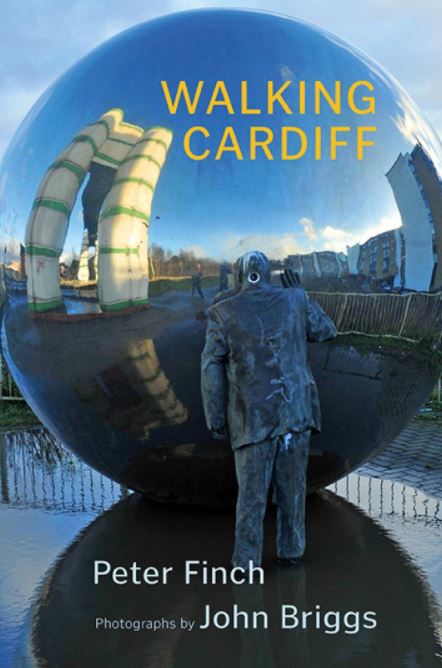
My adventure today was to follow the route entitled ‘The Republic of Roath’ in Walking Cardiff by Peter Finch. It’s a beautifully written book, as are all Peter’s works. Here is not the place to reproduce sections of the book, nor for that matter the excellent photographs by John Briggs. Instead you’ll have to make do with my ramblings and my less impressive photographs.
The route started off in town, outside the City Hall, then headed for Cathays before scything its way through the heart of Roath. In fact it began at the Lord Ninian statue, one I am familiar with having put together a treasure hunt based on some of the civic centre statues of Cardiff last year. Today, Lord Ninian not only has his view of the City Hall blocked by the conifer tree that has grown but he also has to endure the sights of Winter Wonderland, which will no doubt keep him well entertained.
The South Africa war memorial next to the City Hall is indeed one of those often overlooked by people like me who spend time researching names on war memorials. I normally concentrate on WWI and WWII, maybe because they are easier to research. One day I intend my work on the Roath Virtual War Memorial will take in the names on this memorial.
The walk route then took me into Alexandra Gardens. This is a park I love visiting on long summer evenings. The flower displays are excellent and it’s a place to witness the cosmopolitan nature of our city; residents, students and visitors. There were still a few brave flowers making an appearance in the borders today, this late in the year.
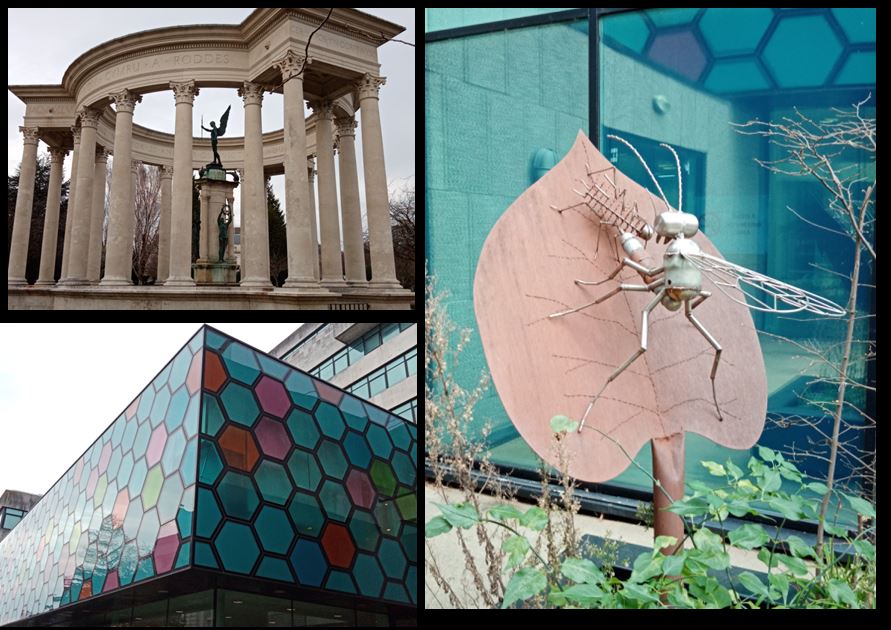
I cut through to Park Place between the Sir Martin Evans building and the main Cardiff University building. There were still a handful of students around, probably the PhD students with an experiment to complete of a paper to finish before heading home. The Martin Evans building is decorated in multi-coloured hexagon glass but what caught my eye today was the sculpture of an insect on a leaf seemingly injecting another, all in the name of research no doubt. It is a sculpture commemorating the life of entomologist Dr Mark Anthony Jervis.
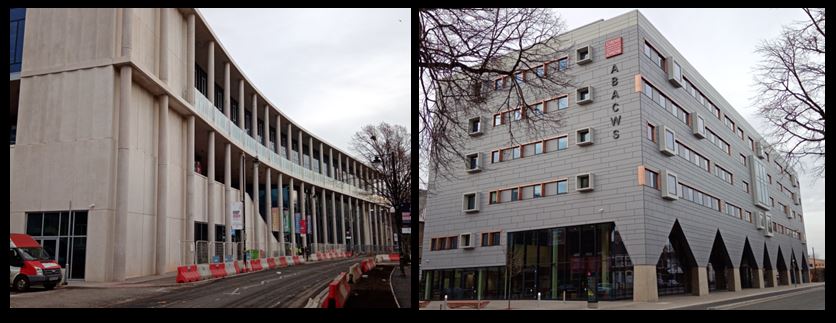
The Centre for Student Life building which had only started being built when Walking Cardiff was published is now open, with just a row of red and white plastic barriers distracting your eyes from the vista. Do I like it? I’m trying my best to. The tall pillars are different but I remain unconvinced, particularly the way the building has been pushed towards the road. Having said that, it is better than another non-descript box-like structure.
The footbridge took me over the railway line into Cathays and another new building to look at, this time the new Department of Mathematics Abacws building. Again it is better than just a non-descript box and I like the way the angles on it contrast with those of the curves on the nearby Sherman Theatre.
I’ve recently started a new challenge – Armchair Travel Challenge where the aim is to visit every country in the world – virtually. I’m spending a month in each, learning as much as I can, trying the food, listening to music and a host of other things. This month is Libya and I had heard that the owner of the McSims Maltese Bakery was from Libya. One of the aims of my challenge is to meet someone from each country, so it was great to meet Adnan Arashi and his son-in-law who run McSims Maltese Bakery on Senghenydd Road. Their pastizzi signature bakes were very tasty. They gave me lots of hints about Libyan food as well as some history and what to look out for as a tourist.
The student streets of Cathays were quiet today. I walked down Miskin Street, past the site of Miskin Street Bible Christian church which fell into disuse and was later demolished. It was where Sir William Crossman attended, the first labour Lord Mayor ever to be knighted. He lived a simple life in nearby Harriet Street.
I cut down Lowther Road. Peter was right, Dan Green’s Uganda art work has now disappeared to be replaced with a keyboard, the musical kind not the computer kind. There was time to view a bit more street art before heading up Northcote Street and the Gateway Christian Spiritualist Church which most people pass without even realising it is a church.
I stopped at the traffic lights, not just from the fear of being run over, but also to cast an eye at the house where Viscount John Sankey, Lord Chancellor – Roath’s top brief, grew up and is now Souvlike Greek restaurant. Across the road is the Roath Park Hotel, hanging on by a thread from the threat of being torn down and replaced by more flats. The redevelopers have said they are open to offers from people looking to return it into a business or community venture but I suspect it is going to require not just ideas but also a sizable cash offer.
One building that appears safe, at least for the present time, is the Mackintosh Sports and Social Club. Although it may not look like it necessarily, it has a long history by Roath standards, and was originally home of the Richards family in the 1800s, the heir of whom married chief of the Mackintosh clan, Mackintosh of Mackintosh. They sold off the Roath land for housing and hence many of the Roath streets have Scottish names.
I walked along Keppoch Street and Cottrell Road, across Albany Road and Wellfield Road, too slow to snap the elderly Mods on their scooters, and into Bangor Street. That’s one street I have never found out the origin of the name. Is it named after Bangor, Northern Ireland or Bangor, North Wales or somewhere else I wonder?
I was on home dog-walking territory by now. I crossed Pen-y-lan Road and into Roath Brook Gardens then Roath Mill Gardens. Signs of Christmas are already here, people out walking in family groups. I was approaching the very heart of Roath, where the old mill used to be. In winter you can just about see some remains of the old wall on the river bank. Roath used to be the bread-basket of Cardiff, a rural population supplying food to those who lived in and around Cardiff Castle. The sculpture of the former mill by Rubin Eynon is holding up well. Almost opposite on the other side of Sandringham Road is the home of poet and physician Dannie Abse, tastefully commemorated with a slate plaque.
My walk finished at St Margaret’s church, the Parish church. the graveyard is largely devoid of headstones now after most were removed decades ago. One interesting one remaining is that of Thomas John whose headstone reminds us that he fought at Waterloo. His history is explored in the latest edition of the Roath Local History Society newsletter.
So why is the walk called the Republic of Roath. I guess that’s another reason to buy the book.












 My adventure today was to follow the route entitled ‘The Republic of Roath’ in


 Cardiff Capers