

For the history of churches in the Roath, Splott, Adamsdown, Tremorfa, Cathays and Pen-y-lan areas see my research on the Roath Local History Society churches page. Scroll down to read about the history of some of the other churches in the city:-
Ararat Baptist, Whitchurch
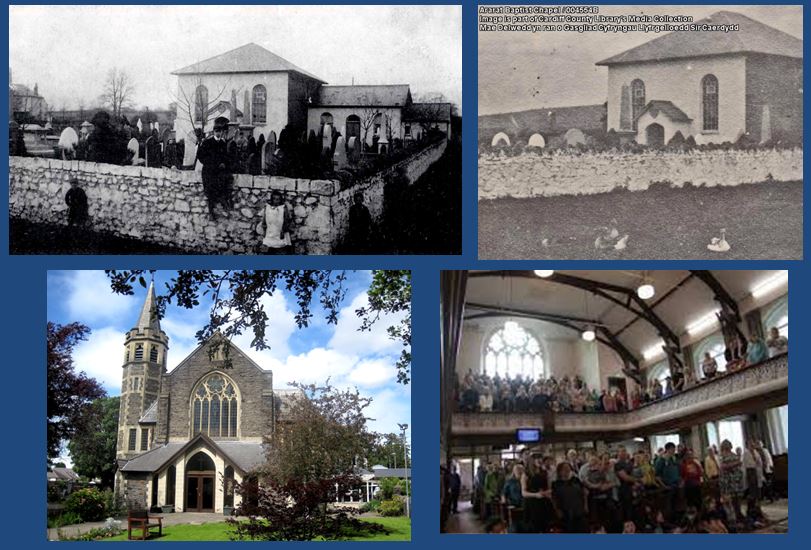
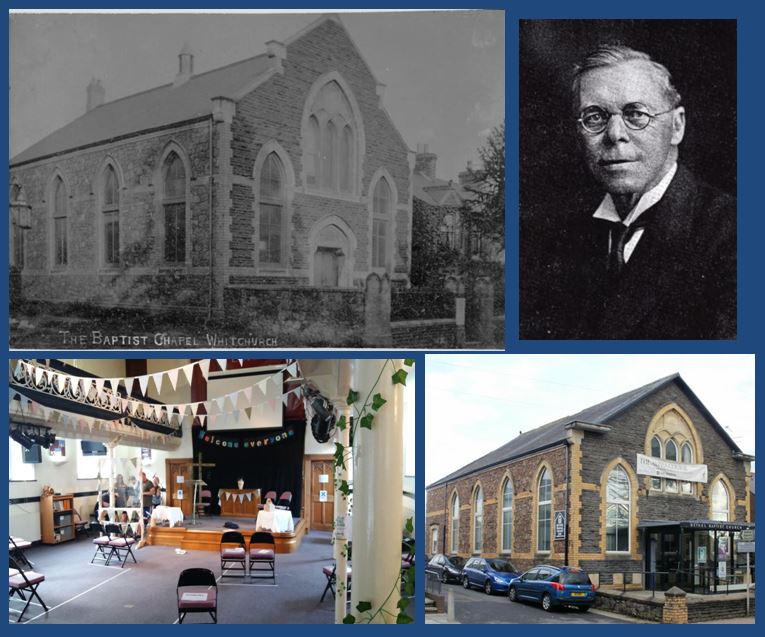
Ararat Baptist church began about 1824 as an offshoot from the Baptist church at Lisvane (Llys-faen) but the building was not completed c1828. It was modified in 1836 and rebuilt in 1851 for the first time. It was It was located on a corner of Waun Treoda common, hence its familiar names Capel y Waun and (sometimes) Waun Treoda, and baptisms were conducted, until the opening of a baptistry in 1879, in a pool near Cornel-y-waun farm. The church appointed its first minister John Williams; minister 1828-40). In 1883 the newspapers contain a number of articles regarding arguments and a split in the congregation. Welsh was used exclusively in services till 1878 when they became bilingual. Increasing anglicisation led to the dropping of Welsh in 1905 and the last Sunday School in Welsh was in 1907. The rapid urbanisation of Whitchurch in the 19th and 20th centuries required rebuilding of the church in 1851 and again in 1915 (the present structure). The building was designed by the architect William Beddoe Rees of Cardiff and built by E.Turner & Sons, also of Cardiff. It is stone built in the Gothic style with a gable-entry plan and two storeys. The church has benefited from a number of energetic ministers over the years, notably John Williams, James Bevan (1885-99) and Luther Jones (1919- 44).
Bethany Baptist, City Centre
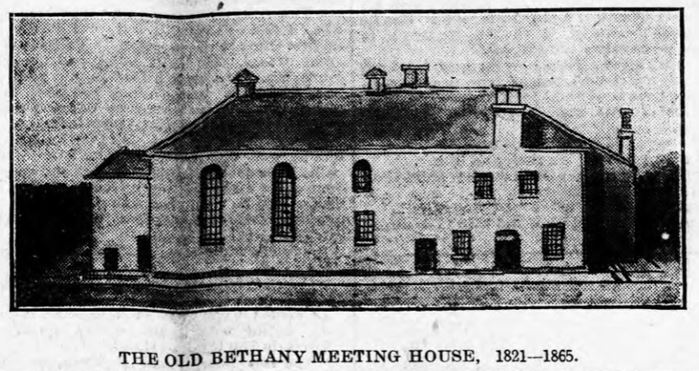
Bethany Baptist was formed on 7 Sep 1806 when three adults, Edmund Ward, Thomas Hopkins and Keziah Viner were baptised in the River Taff near the old Cardiff Bridge. In the evening, they joined three others for worship, George Brown, Thomas and Sarah Lewis ‘in a large room belonging to the King’s Head Hotel and opposite the County Gaol in St Mary Street’. It was the birth of Bethany which is known as the first English Baptist Church in Cardiff and home of the first Sunday School in Cardiff. They were there for just four months before being asked to leave. They purchased the freehold on s granary building with large stables on St Mary’s Street for £300 and spent another £200 on structural alterations. The granary opened for divine service in July 1907. The first pastor of Bethany was Rev Thomas Lewis, a Caerphilly tallow chandler, who used to travel to Cardiff over Caerphilly mountain on a shaggy tailed pony with his wife and child sat behind him. The church was rebuilt in 1821-1827 and enlarged in 1840.
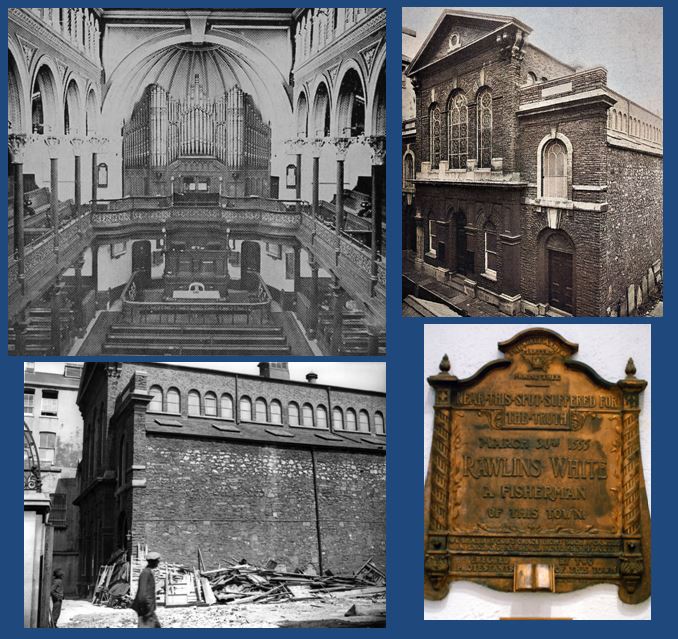
By 1865, Bethany was ready to move into a new building in St. Mary Street, built in grand Lombardic style by John Hartland. The chapel was a large building on a gable-entry plan seating around 950 people with a Sunday school to the rear which was built in 1878 and surrounded by burial grounds. Other building were constructed around Bethany and by the 1950s it was virtually surrounded by Howell’s department store (now House of Fraser). With congregation numbers dwindling an agreement was reached to sell the chapel to Howell’s and the money raised was used to build a new Bethany Chapel in Rhiwbina in 1964 (see separate entry). Rather than demolish the old Bethany chapel Howell’s subsumed it into the architecture of the department store, much of which is still identifiable today. The chapel still contains a plaque memorialising fisherman and martyr Rawlins White who was executed in 1555 in the centre of Cardiff for his protestant beliefs. He is said to have been given opportunity to escape and renounce his beliefs but refused to. When his time came to be executed he asked his wife to bring him his wedding outfit so he would look his best. It is even said he helped neatly build up the wood around his feet.
Bethany Baptist, Rhiwbina
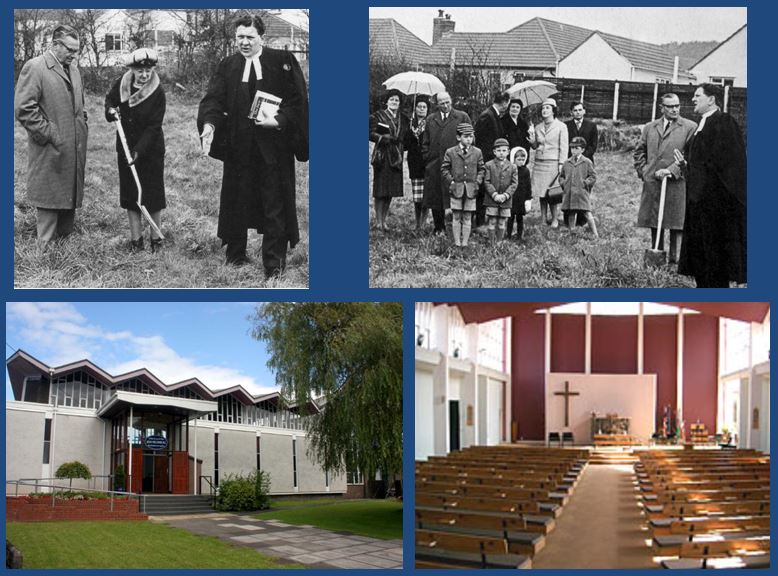
Bethany Baptist, Rhiwbina can trace its history back to Bethany Baptist in the city centre (see separate entry) which started in 1806 and thus the oldest English Baptist church in Cardiff. When the original church was sold to Howell’s Department store the money raised was used to construct a new Bethany Baptist in Rhiwbina. The turf for the new building was cut in Dec 1963 and the church opened the following year. The building is of ‘extravagant architecture’ with an undulating roof over gabled windows and a dramatically painted interior. A baptismal pool, marble pulpit and brass plaques recall the old Bethany chapel in town.
Bethel Baptist, Whitchurch
Bethel Baptist Church was formed in 1865 with services at the time held in a small thatched cottage. (Newspapers in 1902 report that the thatched cottage was then occupied by Mr John Lewis as a shop, so it was probably the drapers shop next to the Maltsters Arms run by John Arnott Jones). Bethel was formed by a group of people who split away from nearby Ararat Welsh Baptist church over the vexed question of the Welsh language. As the church grew it moved to a barn on Wauntreoda Farm on the east side of Whitchurch Common for two years. Land in Whitchurch main street was purchased and a chapel building constructed. In 1884 a building fund was started with the aim of building a more permanent structure. The shipowner Richard Cory was a large benefactor. The present Bethel Baptist church opened in 1894 at the cost of £1024 and was built in front of the old chapel in simple Gothic style with a gable-entry plan. The church continued to grow under the ministry of Rev J Arthur Jones who was said to deliver ‘thoughtful and pointed’ sermons. A gallery was added in Nov 1900 taking the seating capacity to between 500 and 600. In the first two years of the twentieth century 92 members joined the church and two hundred children were attending the Sunday School. A new organ was added in 1927.
Friends Meeting House (Quakers), City Centre
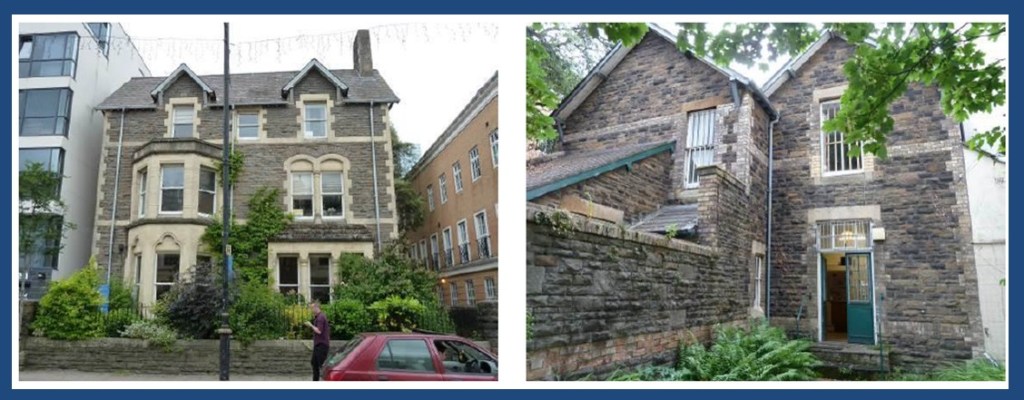
The Quakers met in private houses until 1838. That year, they leased a house near the corner of Charles Street and Queen Street to be used as meeting house. In ~1860 the meeting was closed and the building was let to United Methodists (1856-64) and then to a school. The meeting was revived in 1872, soon after which the meeting house (by then in poor repair) was demolished. In 1888, a new purpose-built meeting house was erected on the same site for an estimated cost of £1,400. This building seated 300 and opened in 1889. In order to pay for the site, the coal below the building was reportedly sold. That building was sold in 1931 and subsequently demolished. In 1931, the current Friends Meeting House in 43 Charles Street was purchased. This was previously a Victorian vicarage of c.1860. In 1921 Canon Morgan Jones-Powell, vicar at St John’s lived there. A number of the upper rooms are now rented out to tenants as offices and counselling rooms, while others are reserved for Quaker use.
Hope Baptist, Canton, now called Calvary Baptist, Canton
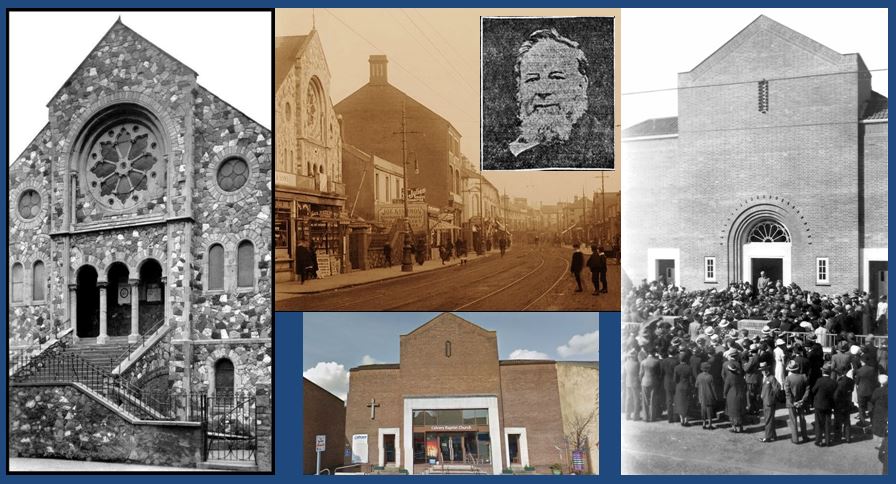
Hope Baptist Church in Cowbridge Road was established in 1858 by members of Bethany Baptist in the centre of Cardiff who donated £600 of the £1000 cost. The church was designed by Habershon & Fawckner in Lombardic style and constructed using variegated stones. The church itself was elevated form the street level and had schoolrooms beneath. As church numbers grew a new church was constructed behind the original 1880, today used as a schoolroom. In 1889 Sunday School scholars had a narrow escape when their Whitsun Treat wagon overturned on a trip to Court-y-rala. The Pastor between 1889 and 1910 was Rev Thomas William Medhurst who was converted and baptised by Charles Spurgeon and became Spurgeon’s first pupil. In 1915 the Hope Baptist pastor Rev.S.Petty was killed when he was knocked off his bicycle in the outskirts of the city by a car. In 1936 the ornate front chapel was demolished and replaced the following year by a new brick-built church. In 1971 Hope Baptist combined congregations with Victoria Baptist in Riverside and renamed itself Calvary Baptist church. The frontage of Calvary has been modernised in recent years to include a glass frontage and foyer giving a more welcoming appearance.
Norwegian Seamen’s Church, Cardiff Bay
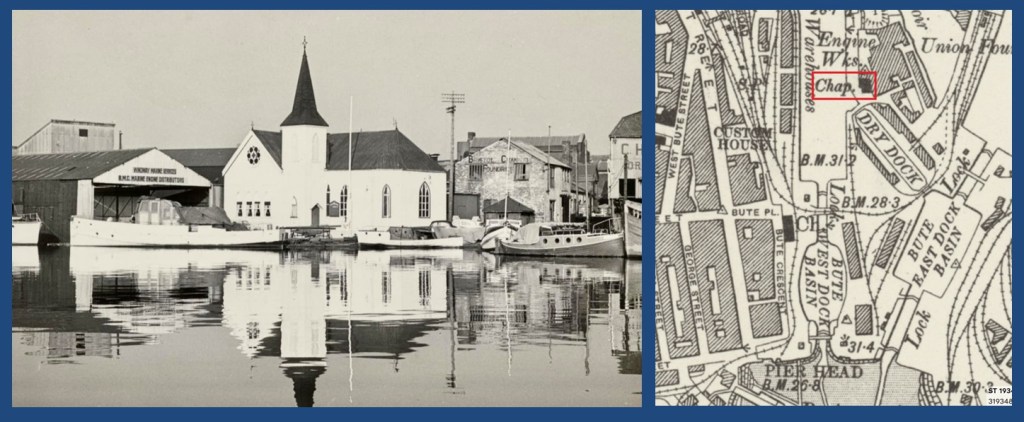
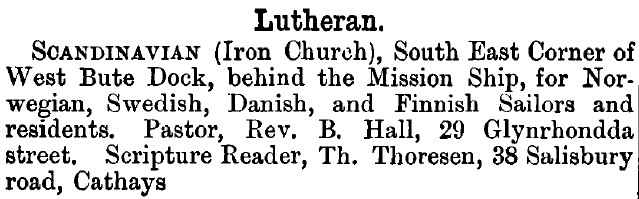
The Norwegian Church originally stood at the side of West Dock, roughly where the southern exit from the Red Dragon Centre is now. It was built in 1868 and the author Roald Dahl was baptized there in 1916. The church closed in 1974, was dismantled in 1987 and moved and reopened as an Arts Centre in its present location in 1992. In its original position it was the centre of Scandinavian religion, culture and tradition in the area acted as a Seaman’s mission with Scandinavian newspapers, magazines and facilities for writing letters home. In the 19th century the church welcomed up to 70,000 seafarers annually, with many social evenings being held and a place where sailors could relax and converse with friends in their native tongue.
Rumney Baptist – Alfred Tilly Memorial Baptist Church
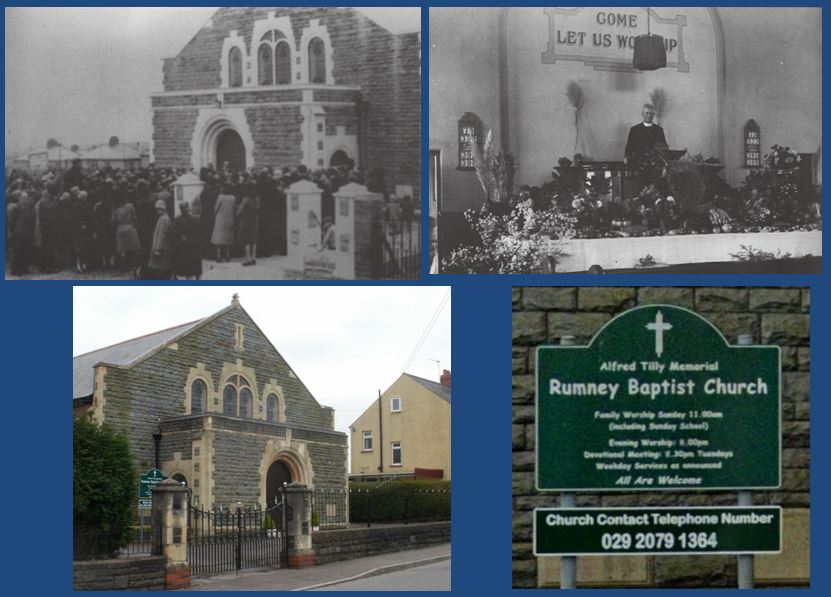
The history of Rumney Baptist Church can be traced back to 1882 when a group from Tredegarville Baptist church came to Rumney and started meeting in the parlour of Edward Tugwell’s house. Eventually a piece of land alongside Mr. Tugwell’s home was acquired for the construction of a church building by Messrs. W.E. Turner & Son, Mr. William Turner on the site of the now Roman Catholic Church in Wentloog Road. The church was opened on Nov 27 1889 by the Rev. Alfred Tilly. By the 1920s it was becoming apparent that the building was too small to house the congregations it was attracting. A new site in Tyr y Sarn Road was rented and the present church was opened on 23 Sep 1929. The church hall was opened on 7 Oct 1948. The church is called the Alfred Tilly Memorial Baptist Church after the first minister. Alfred Tilly started Tedegarville Baptist church after leaving Bethany Baptist Church. .
St John the Baptist, City Centre
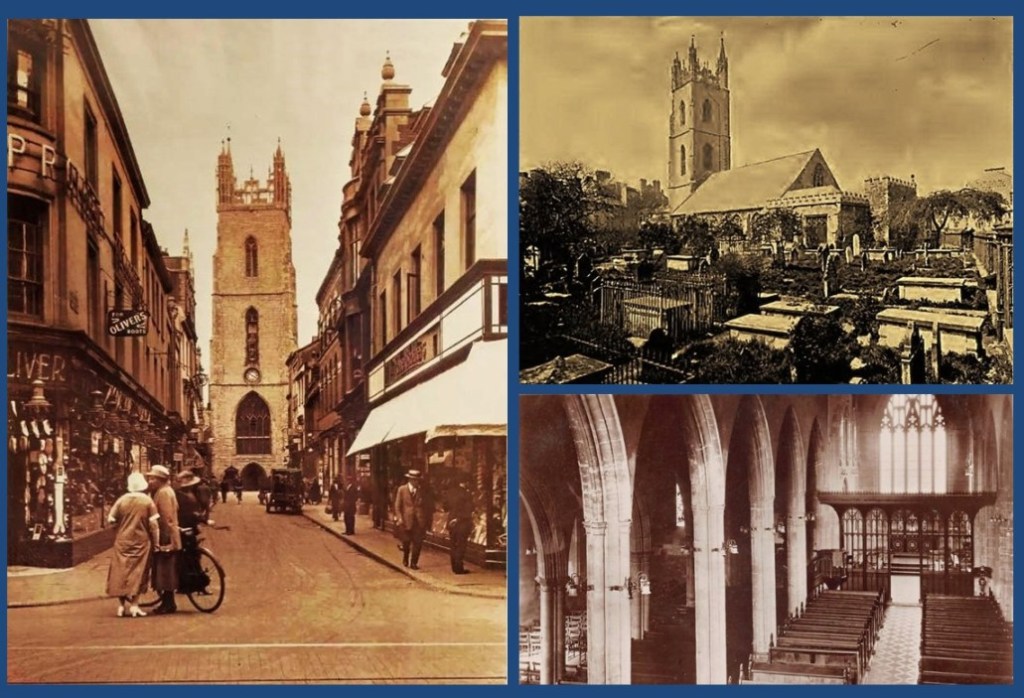
This is Cardiff’s oldest church dating back to medieval times. It had been built by 1180 and was a ‘chapel of ease’ to nearby St Mary’s (now gone). A chapel of ease is a supplementary church built within a large parish to serve those who live too far from the main parish church. The original St John’s church is said to have been destroyed when Owain Glyndwr in 1404, hence the irony in the nearby pub being called the Owain Glyndwr. The St John’s was rebuilt in the second half of the 15th century with the tower built in 1473. Further reconstruction took place in the late 1800s with an extension added, new pews and stain glass windows installed. A new public pathway connecting Working Street with Cardiff Market was built in the 1890s. As part of the agreement for the new path, Cardiff Council agreed to take responsibility for the graveyard south of the path which later became St John’s Gardens. The path is still owned by the church and is closed every Good Friday. Look out for the brass numbers on the path marking locations of graves and family tombs.
Saint Mary, City Centre
Saint Mary’s church is no more. The church was badly damaged when the River Taff flooded in 1607 with bones and coffins from its graveyard being washed out to sea. Accounts state a mini tsunami swept up the Bristol Channel! Saint Mary’s was finally abandoned in 1701. In those days the River Taff flowed adjacent to the church but it was later rerouted to enable the railway station to be built.The church gave its name to nearby St Mary’s Street. A new St Mary’s church was later built on Bute Street, south of the railway station. The current Prince of Wales pub now stands on this church’s original site. On the side of the pub on Gt. Western lane entrance is an unusual outline of the original Saint Mary’s church.

Trinity Chapel, Womanby Street, City Centre
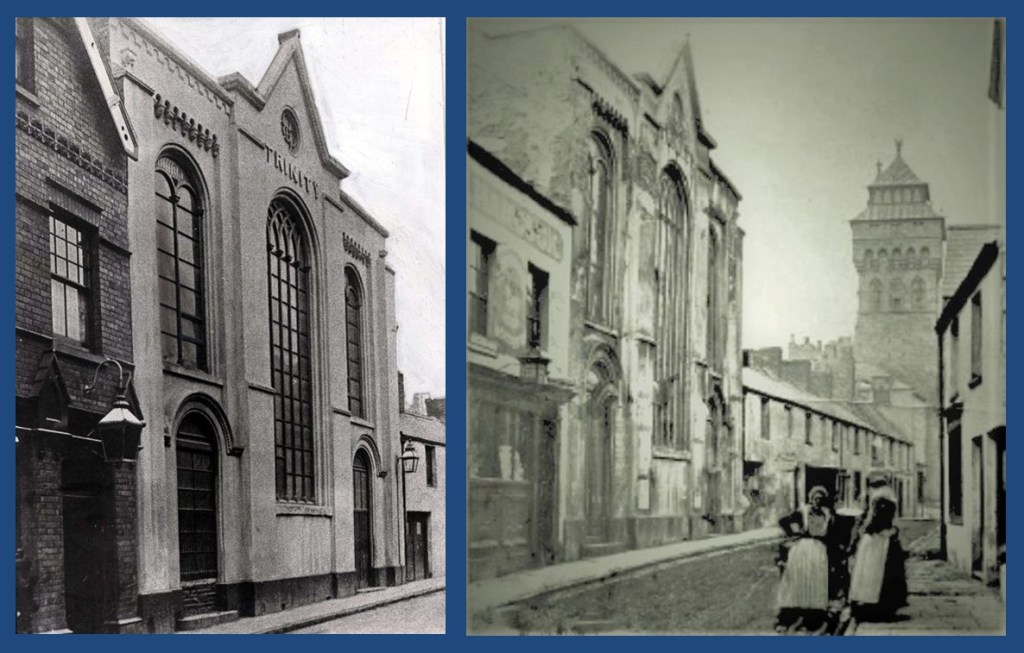
Trinity Chapel was Cardiff’s first nonconformist chapel in 1697 founded by the followers of William Erbery. Erbery had been dead 45 years by that stage but his followers and their descendants are thought to have continued to meet in secret after his death, until in 1697 they were given the freedom to build their own church. The original Trinity church burnt down in 1847 but was replaced soon afterwards with a fine classical frontage, the name ‘Trinity’ incised into the stonework. A number of daughter churches were created including Charles Street Congregational and Llandaff Road. John Bachelor (staue in The Hayes) was a member of Trinity church. In 1888 Trinity Church was amalgamated with Llandaff Road Church and the Charity Commissioners approved the sale of Womanby Street Church, the proceeds of which were used to erect a new church in Cowbridge Road for the united congregation. The united congregation met in Llandaff Road Church until the new church, known as New Trinity Church, was opened on Cowbridge Road. The chapel on Womanby Street was demolished and looks at one stage to have been a garage and when that was demolished more recently it was being used as a car park. It is now the beer garden for the Fuel Rock Club.
Victoria Baptist Church, Riverside
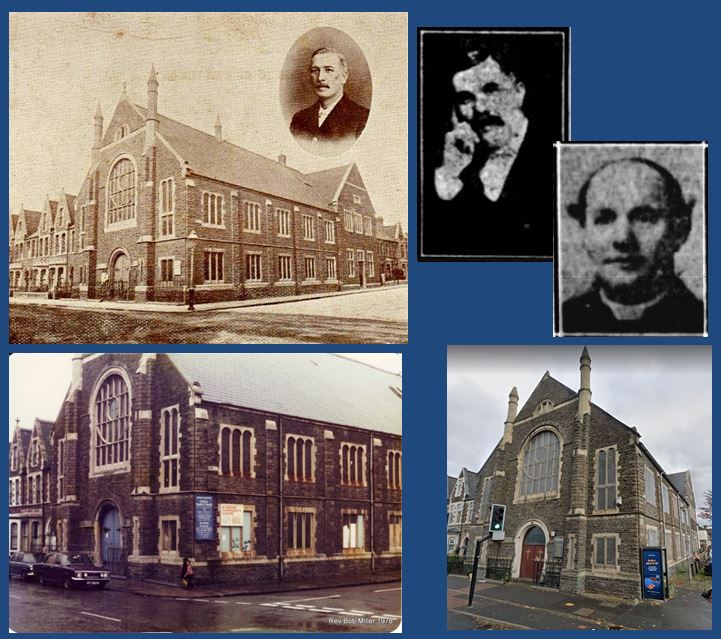
Victoria Baptist Church sat on the corner of Ninian Park Road and Brunel Street in Riverside. It started, probably in the 1880s, as a mission room meeting in Craddock Street and had been set up by Bethany Baptist under the leadership of William Jones, a printer, from Duke Street and Mr T.Davies, a tea merchant. In Sep 1886 commemorative foundation stones were laid for a new church in Brunel Street. That church became known as both Riverside Baptist Church and Eldon Road Baptist (Eldon Road being a road now called Ninian Park road). The church flourished in numbers and ten years later in 1896 foundation stones were laid for a new much larger church facing Eldon Road. The church, designed by Habershon and Fawckner would seat 314 on the ground floor and 274 in the galleries. The building opened in Jul 1897. Newspaper reports tell us something of the ministers employed: The first minister was Rev.T.Lodwig Evans but he moved on in 1899. Rev.E.Aubrey was another minister and he left for Pennsylvania, USA in 1912. When Rev Aubrey was minister it is reported that 600 people on average attended Sunday evening services. Rev.J.R.Bryant arrived at the church in 1921. The building is said to have been vacated in 1972 when Victoria Baptist merged with Hope Baptist to become Calvary Baptist Church and moved to Cowbridge Road (the picture of the church labelled as being taken in 1978 is confusing however as it shows a sign for Calvary Baptist outside). In recent years the church has been used by the Cardiff branch of the Shiloh Pentecostal Fellowship. The building at the rear of the church is used by the South Riverside Community Development Centre .
Wood Street Congregational – City Centre
Wood Street Congregational Chapel was founded as a Temperance Movement Concert Hall in 1858 and later converted into Wood Street Congregational Church, once the largest congregational chapel in South Wales after renovations and extensions in 1896. In it’s heyday 2000 people regularly attended its services at Temperance Town . It was demolished in the 1970s.

Zion Chapel, City Centre
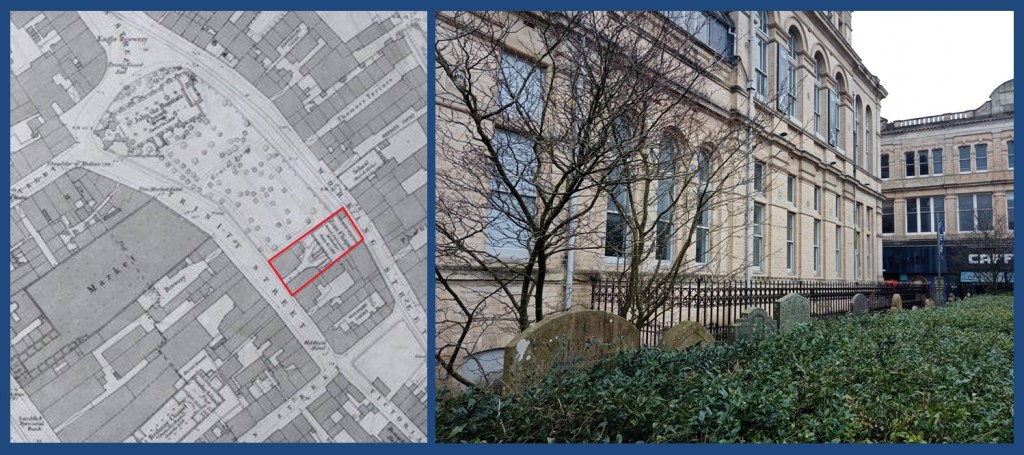
Zion Welsh Calvinistic Methodist Chapel stood adjacent to St John’s graveyard, between Trinity Street and Working Street. I have not yet discovered the date it was constructed but it seems to appear in the newspapers in the 1850s until it closed in the 1870s. The land it stood on was required by the Council to build the Free Library, the building still standing there today. In around 1877 the trustees of the church were offered £1,500 which they used to construct a new chapel in Pembroke Terrace. The chapel in Trinity Street had its own graveyard. In 1855 the body of a still born male child was discovered dumped in the graveyard. On a lighter note, in 1869, a little boy named David Griffiths, appeared before a magistrate charged with digging a hole four feet deep and six foot long in a stable adjoining the burial ground for Zion Chapel, Trinity Street. The boy stated in cross-examination that he had only asked a man to dig him the hole as he and some other boys were in the habit of playing at hide and seek, and he wanted a good place to hide himself in. The magistrate had a good laugh about the matter, and instantly dismissed the juvenile offender.
 Cardiff Capers